


Digital

Despite increasing concerns over rising interest rates and increased price sensitivity, prime London residential values have remained remarkably resilient this year particularly in the city’s exclusive central districts, according to international real estate firm Savills.
The fundamentals of what attracts residents to London remain clear – business hub, connectivity, time zone, tourism and education – and buyer demand has continued to be stronger than many had expected.
In the first six months of 2023, new buyer registrations across Savills central London offices were 44% higher than their pre-pandemic average. For tenants, that figure is 31% higher when compared to H1 2019, clearly underscoring the appeal of living in the UK capital, with significant demand from corporates relocating from overseas.
“International travel has picked up since the start of this year, led by passengers from Asia, the Middle East and the US. This has translated into increased demand, though buyers at the top end of the London market remain discerning against the backdrop of macroeconomic uncertainty,” notes Frances McDonald.
Prices across London’s prime markets slipped by -1.0% on the year to the end of June, according to the Q2 Savills prime London index, outperforming the wider UK market. This leaves values 3.9% above their pre pandemic level, yet still -6.1% below their previous 2014 peak.
Prime central London has held up better than outer prime London, indicating a growing divergence between cash and equity rich buyers and other groups in their ability to transact, and between the very top end of the market and lower value segments.
Year to date, cash buyers have accounted for 71% of prime central London deals, up from 58% in 2022, according to Savills records.
This has translated into a divergence by price point with more expensive homes, those worth more than £5 million, seeing prices remain broadly flat (-0.2%) in the past year. Property in central London worth less than £2 million, a market in which buyers are more likely to be reliant on debt, fell by a more substantial -1.9%.
At the same time, rents across prime central London have continued to increase, albeit at a slower rate than in 2022. Still, they are now 20.9% higher than they were two years ago when the capital opened up after the pandemic, and an influx of demand soon followed.
The £5 million-plus market in detail:
Transactions for London homes worth more than £5 million also continue to be resilient. A total of 240 such sales were recorded in the first half of the year. While this marks a -21% fall compared to the first six months of 2022, it is on par with the same period in 2021 and 45% above the H1 average for the three years pre-pandemic.
Schemes such as The OWO, Chelsea Barracks and The Whiteley have met a growing requirement for turnkey properties from a discerning group of UHNWIs who are drawn to properties that are demonstrably best in class. But buyers are increasingly recognising that supply of such world class properties is extremely limited, particularly when compared with locations such as New York or Dubai.
And supply of quality stock is likely to become increasingly constrained, Savills notes, as changes to planning regulations limit any future new homes built in Westminster to 200 square metres, with similar restrictions anticipated in Kensington and Chelsea. This means there is now a finite supply of world class homes at this size in the £5 million-plus bracket.
At current rates of sale, and with just 15 schemes currently under construction delivering homes of this size, Savills estimates that stock will be exhausted within five years.
“A lack of opportunity for developers and local government restrictions on the size of residences is likely to squeeze supply of these grand apartments that have been much sought after by the world’s financially elite, both from home and abroad,” says Ed Lewis, Savills head of London residential development.
“Prime central London must obviously deliver a wide and varied mix of accommodation to meet all the requirements, including value, for those that call London home, but it’s become clear that those buyers looking for the best, in one of the world’s few truly International cities, may be frustrated by the lack of choice in future years.”
Related News
 Digital
 Digital
 Digital
 Digital
 Digital
 Digital
 Digital
 Digital
 Digital
 Digital
 Digital
 Digital
15-07-2018

QIB Profit grows by 13.8% to reach QAR 1,325.3 Million for six months’ period ended 30th June 2018 Total Assets reach QAR 152.5 Billion
Read More
 Digital
 Digital
 Digital
18-10-2017
QIB Profit grows by 10.6% to reach QAR 1,775 Million for the nine months’ period ended 30th September 2017
Read More
 Digital
 Digital
 Digital
 Digital
 Digital
 Digital
16-04-2017
QIB Profit grows by 13% to reach QAR 555 Million for three month period ended 31st March 2017
Read More
 Digital
 Digital
 Digital
 Digital
 Digital
12-06-2016
QIB Named ‘Islamic Bank of the Year’ in Qatar and the Middle East by The Banker
Read More
 Digital
05-06-2016
QIB Recognised as “Best Bank in Qatar” at the Annual Euromoney Awards for Excellence
Read More
 Digital
20-04-2016
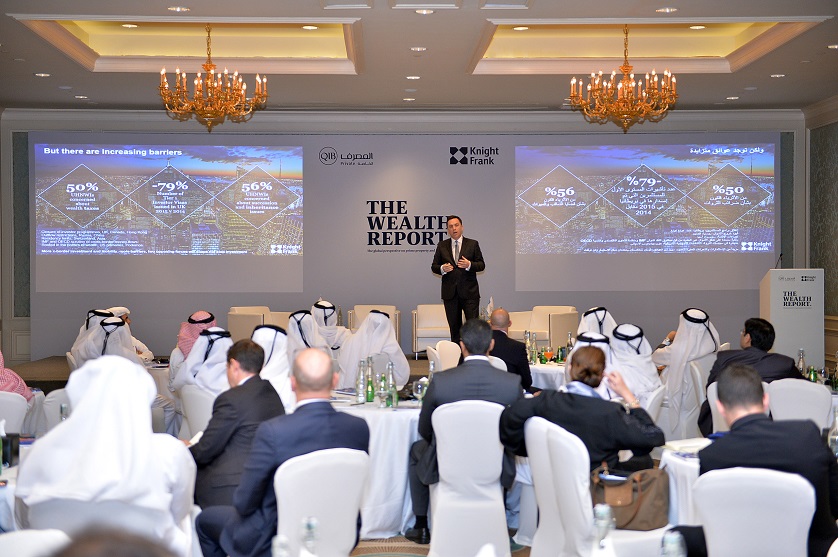
Qatar Islamic Bank Hosts Exclusive Preview of the Knight Frank 2016 Wealth Report
Read More
 Digital
 Digital
 Digital